Weird's a weird word. Over and above simply denoting a significant deviation from the norm, weird satisfies its own definition even in contemporary English. Just by existing, weird manages to throw out the wonderfully helpful though trite rule of "'i' before 'e' except after 'c'." Weird's weirdness, as it were, goes much further back in time and reaches deeper levels than just having a rule-bending spelling, however. Weird's beginnings can be found in the translation of the Norse word "uror," or "wyrd" in English, meaning either one of the Norns or fate itself. The word, tracked through time, has come to be used in such constructions as "weird sisters" to refer the trio of witches--Norn reference, perhaps?--in Shakespeare's Macbeth or, more recently, the "weirding way" of the prescient Bene Gesserit in Frank Herbert's Dune.
I'm curious to learn more about weird primarily because I'd like to learn more about how the word began as something associated solely with fate and became a word with a much more commonly applicable meaning. Additionally, the transformation of "wyrd" into "weird" seems like a rather bizarre etymological shift, because there is little reason to believe that "weird" makes any more grammatical sense than its predecessor. I'm interested in weird mostly for its weirdness.
Monday, November 7, 2011

Tuesday, November 1, 2011
Frankenstein: The True Story
--Frankenstein is ultimately interpretable. Because the text is so greatly misunderstood and misrepresented by almost every one of its reproductions, critics are not only free to draw any conclusion they want from it, but almost feel compelled to spread their enlightening words to the masses.
--Despite Shelley's reluctance to place any sort of external meaning on her text, that mysteriousness is exactly what has encouraged critics to search for meaning. The phenomenon of applied meaning to Frankenstein is a sort of precursor to the death of the author. Perhaps more important is that critics very rarely interact, with each interpretation of Shelley's novel existing in a kind of heterogeneous soup of theory.
--Most contemporary Romantic critics believe the monster to be unfailingly sympathetic while failing to look at any of Victor's redeeming qualities or the creature's vices. Indeed, their opinion is that the creature is an example of what humans should be while Victor is one that should be reviled. Contemporary criticism as reached consensus against opinions, rather than embracing a plurality.
--The core of Frankenstein's value lies in its ability to present readers with insoluble problems that must be approached from both sides, not in forcing readers to choose one in particular. While choosing one perspective may not be wrong, the forceful methods many teachers take to informing their students about them often crowd out other modes of thought.
--Rousseau might provide an overly simplistic reading of Frankenstein. Though the creature is the essence of Rousseau's thought, the idea that Victor is inherently flawed because he is part of human civilization and that the creature is inherently good because he is not cheats the reader of much of the moral tension that Shelley sought to create.
--Despite Shelley's reluctance to place any sort of external meaning on her text, that mysteriousness is exactly what has encouraged critics to search for meaning. The phenomenon of applied meaning to Frankenstein is a sort of precursor to the death of the author. Perhaps more important is that critics very rarely interact, with each interpretation of Shelley's novel existing in a kind of heterogeneous soup of theory.
--Most contemporary Romantic critics believe the monster to be unfailingly sympathetic while failing to look at any of Victor's redeeming qualities or the creature's vices. Indeed, their opinion is that the creature is an example of what humans should be while Victor is one that should be reviled. Contemporary criticism as reached consensus against opinions, rather than embracing a plurality.
--The core of Frankenstein's value lies in its ability to present readers with insoluble problems that must be approached from both sides, not in forcing readers to choose one in particular. While choosing one perspective may not be wrong, the forceful methods many teachers take to informing their students about them often crowd out other modes of thought.
--Rousseau might provide an overly simplistic reading of Frankenstein. Though the creature is the essence of Rousseau's thought, the idea that Victor is inherently flawed because he is part of human civilization and that the creature is inherently good because he is not cheats the reader of much of the moral tension that Shelley sought to create.
Sunday, October 2, 2011
Of Knights and Hobbits: A Comparison of Heroes
Epic poems and literature provide a glimpse into the hopes and aspirations of a civilization; an author crystallizes society’s myriad quirks of idealism and valued traits from the abstract ether of imagination into a single, concrete entity—the hero. Sir Gawain and the Green Knight is no less a window into the mind of 14th century England via the character of Gawain, who exemplifies Arthurian chivalry, courage, and honor. By no means is the position of the hero filled only with armed and armored knights who can hold their own both at court and on the battlefield, however—equally important is the heroism represented by Frodo in Tolkien’s Lord of the Rings. While a three-foot tall halfling and the jewel of Arthur’s court might at first seem to have little to nothing in common, both characters represent very similar loci of privileged traits.
A sense of ethics and morality is one of the areas in which Gawain and Frodo are most similar, though they receive uniquely different circumstances in which to display it. Gawain—very much a product of his time period—is at his most moral when he can display his honesty and resistance to temptation. Gawain’s keeping his bargain is in and of itself a virtuous act, as he divorces the act from anything more than keeping his word and sets forth to find the Green Chapel and uphold his end of the Green Knight’s bargain, telling Arthur, “The terms of this task too well you know / To count the cost over concerns me nothing / But I am bound forth betimes to bear a stroke” (546-548). Gawain also proves his moral mettle when the lady tries to seduce him, couched by the narrator specifically in terms of resistance to sin:
Then she tested his temper and tried many a time,
Whatever her true intent, to entice him to sin,
But so fair was his defense that no fault appeared,
Nor evil on either hand, but only bliss (1549-1552)
Frodo’s morality manifests in a much more metaphorical representation of temptation—that of the Ring, through which he could wield great personal power and even possibly overcome Sauron himself at the cost of allowing it to work evil through him. Though Frodo is presented time and time again with the ability to use the Ring for his own gain, he chooses not to do so. While the Ring is possibly a more elemental evil than Gawain’s charming companion, his subordination of his own gain to the greater good is one that is very much the same. An instructive point illustrated by both heroes is that neither of them is perfect—Frodo eventually puts on the Ring at the Cracks of Doom, and Gawain accepts the girdle from the lady. The ethical similarity shared by Gawain and Frodo is not so much that morality means an unfailing defense as that the act of resistance has inherent value.
While morality is a foundational trait of heroes and these two in particular, it remains nothing more than theory unless they also share the courage to put that morality into action—one’s theorizing about morality could stand as a shining beacon of goodness in the blackest cesspit of evil and not matter a whit unless that morality can be translated into deeds. Gawain’s most poignant example of that courage comes when a stranger tells him where to find the Green Chapel and refuses to flee despite the man’s offer of covering up Gawain’s cowardice, saying, “But though you never told the tale, if I turned back now / Forsook this place for fear, and fled, as you say / I were a caitiff coward; I could not be excused” (2129-2131). It is Gawain’s own honor, not the expectations of his courtly fellows or fear for his reputation, that forces Gawain onward despite the knowledge of his swift-coming and potentially grisly end. Frodo has a moment of foredoomed glory of his own at the Council of Elrond, where the Wise have gathered to decide the fate of the Ring. When the Council turns into a screaming match between the participants, Frodo takes matters into his own hands and says, “I will take the Ring to Mordor, though I do not know the way” (add cite here). Frodo’s magnificently self-sacrificing, altruistic gesture mirrors Gawain’s in that both know that they likely will not survive the scenarios into which they are throwing themselves—the hopelessness of both is what makes their courage all the more important.
Sir Gawain and Frodo have innumerable differences—Gawain is confident, powerful, and has already secured a reputation for himself, while Frodo is small, comparatively weak, and known only by a few. Despite those differences, both heroes possess a similar constellation of traits that is common to, and perhaps required for, northern European epic literature. Through courage, humility, and morality, both characters represent the best of what their respective civilizations have to offer.
Thursday, September 15, 2011
Alfred the Great
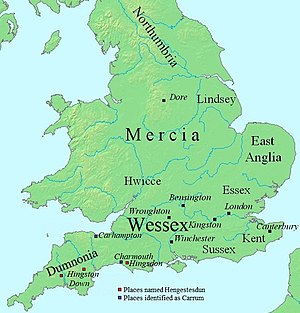
Alfred, whose name literally translates to "elf-counsel," is the only English monarch to still be known by the appellation of "the Great." He was born the fourth son of King Aethelwulf of Wessex, and only became king himself after his three older brothers perished in quick succession. Alfred was responsible for fending off the Vikings--primarily Danes--that were threatening to overrun the Anglo-Saxon population. Alfred's success was primarily possible because he led a mostly united England rather than one that, as had been the case in the past, was fragmented into multiple regions. After ensuring the safety of England from Norse marauders, Alfred turned his attention toward projects to rebuild and restore much of the ravaged countryside, including London, and instituted a codified legal reform based on his Doom Book. Much of what is currently known about Alfred comes from the writings of the Welsh bishop Asser.
Monday, August 29, 2011
Tales of The Handmaid's Tale
The text I selected to serve as my contemporary example of British Literature, Margaret Atwood's The Handmaid's Tale, is not only a fantastic example of compelling storytelling but also one of the better books I've read recently. I chose the book because I'd heard that Atwood's fiction in particular does a good job of addressing feminism, a subject that dovetails nicely with some of the more esoteric authors--read mostly incomprehensible postmodernists--that I occasionally gravitate towards. The Handmaid's Tale managed to live up to the hype, weaving together cutting social insight and a refreshingly self-aware first person narrative.
Perhaps the greatest strength of The Handmaid's Tale's is the way it manages to seamlessly convey profound messages about humanity without interrupting Offred's chillingly clinical and analytic description of events. While the argument that the entire novel functions as a sort of meta-narrative about human nature is certainly valid, there are a few specific examples of Atwood's talent that stand out. First is Atwood's introduction of the character of Moira as a foil to Offred. Where the latter accepts her training as a handmaid as something that is inexorable, Moira holds an Aunt hostage and escapes to freedom. Even when recaptured and sent to Jezebel's--little more than a glorified brothel--Moira represents the capacity of the human spirit for agency even in a situation where it seems as if she has little control over her surroundings. Instead of allowing herself to break in such a bleak situation, Moira uses her body and the power she has over the men who ironically sought to suppress that power in order to maintain her identity and individual agency. This is not the only section of the book where Atwood uses the act of sex as a metaphor for freedom and rebellion--Offred's later physical relationship with Nick is very much characterized as her reclaiming a bit of her past self. Equally important is the Commander's reference to the reasoning behind elevating men as superior during the construction of the Republic of Gilead--apparently many men felt as if they no longer had a distinct role to play in society after having to share their traditional societal roles. After the new regime takes over and creates a society where men are ascendant, however, control over their bodies becomes one of the suppressed women's only forms of emancipatory action. The text's strength lies in discussing such things while at the same time telling an entertaining, horrifying, and insightful story.
While The Handmaid's Tale is strong in almost all of its aspects, its greatest weakness lies in the scope, rather than the detail, of its narrative. Because the story is told entirely from Offred's perspective, much of the nature of the world is left for the reader to interpret from snatches of information Offred manages to glean from the Commander and her fellow handmaids. Readers are granted information about a specific portion of the Republic of Gilead, but the state of the rest of the world is left very much untouched. While the United States has been taken over by religious fundamentalists, Atwood does not discuss events happening in other countries beyond the very limited scope of Offred's experience. While the narrative is perhaps more powerful for being limited and focusing on the experience of a single person, Atwood could aspire to grander implications by describing the state of the entire world a la 1984. Ultimately, scope is a very minor complaint when compared to the significance of The Handmaid's Tale's message--even in the face of the blackest adversity, humans still have control over their fate.
Perhaps the greatest strength of The Handmaid's Tale's is the way it manages to seamlessly convey profound messages about humanity without interrupting Offred's chillingly clinical and analytic description of events. While the argument that the entire novel functions as a sort of meta-narrative about human nature is certainly valid, there are a few specific examples of Atwood's talent that stand out. First is Atwood's introduction of the character of Moira as a foil to Offred. Where the latter accepts her training as a handmaid as something that is inexorable, Moira holds an Aunt hostage and escapes to freedom. Even when recaptured and sent to Jezebel's--little more than a glorified brothel--Moira represents the capacity of the human spirit for agency even in a situation where it seems as if she has little control over her surroundings. Instead of allowing herself to break in such a bleak situation, Moira uses her body and the power she has over the men who ironically sought to suppress that power in order to maintain her identity and individual agency. This is not the only section of the book where Atwood uses the act of sex as a metaphor for freedom and rebellion--Offred's later physical relationship with Nick is very much characterized as her reclaiming a bit of her past self. Equally important is the Commander's reference to the reasoning behind elevating men as superior during the construction of the Republic of Gilead--apparently many men felt as if they no longer had a distinct role to play in society after having to share their traditional societal roles. After the new regime takes over and creates a society where men are ascendant, however, control over their bodies becomes one of the suppressed women's only forms of emancipatory action. The text's strength lies in discussing such things while at the same time telling an entertaining, horrifying, and insightful story.
While The Handmaid's Tale is strong in almost all of its aspects, its greatest weakness lies in the scope, rather than the detail, of its narrative. Because the story is told entirely from Offred's perspective, much of the nature of the world is left for the reader to interpret from snatches of information Offred manages to glean from the Commander and her fellow handmaids. Readers are granted information about a specific portion of the Republic of Gilead, but the state of the rest of the world is left very much untouched. While the United States has been taken over by religious fundamentalists, Atwood does not discuss events happening in other countries beyond the very limited scope of Offred's experience. While the narrative is perhaps more powerful for being limited and focusing on the experience of a single person, Atwood could aspire to grander implications by describing the state of the entire world a la 1984. Ultimately, scope is a very minor complaint when compared to the significance of The Handmaid's Tale's message--even in the face of the blackest adversity, humans still have control over their fate.
Thursday, August 25, 2011
My Top Books
1. Lord of the Rings, J. R. R. Tolkien--Nuanced setting, an incredibly beautiful cosmology, characters that run the gamut of tropes--some created by Tolkien himself--from aloof elves to proud warrior-race.
2. Perdido Street Station, China Mieville--An exemplar of the emerging "strange fiction" genre, Mieville flipped every expectation I had for fantasy novels on its head. A fantastic deconstruction of gender, the Other, Marxism, and interpersonal relationships.
3. History of Western Philosophy, Bertrand Russell--The book that opened my eyes to the entire realm of thought that is philosophy and analytic reasoning. From Aristotle to Nietzsche to Kant, a fascinating exploration of human thought.
4. Postmodern Theory, Best and Kellner--Dovetailing nicely with Russell's seminal work, postmodern theory took what I knew about traditional philosophy and let me apply it to a plurality--fittingly--of topics in new and varied ways. Foucault changed the way I looked at the world.
5. The Uplift War, Dan Brin--A book in which humanity has lifted chimps and dolphins to sentience and had them join society as equals. A fascinating look at the potential social implications of the emergence of sentient life other than humans.
6. Storm Front, Jim Butcher--A modern fantasy novel also about a Harry that is much much better than the alternative. A blend of detective noir, wizardry, and wisecracking protagonist. The rest of the series is equally good.
7. Wizard of Earthsea, Ursula LeGuin--My first introduction to fantasy as a genre, and it did interesting things with its magic system.
8. Infinite Jest, David Foster Wallace--A book about tennis, drug addiction, everything, and nothing. A thousand pages with seventy-five of endnotes. Mind-blowing.
2. Perdido Street Station, China Mieville--An exemplar of the emerging "strange fiction" genre, Mieville flipped every expectation I had for fantasy novels on its head. A fantastic deconstruction of gender, the Other, Marxism, and interpersonal relationships.
3. History of Western Philosophy, Bertrand Russell--The book that opened my eyes to the entire realm of thought that is philosophy and analytic reasoning. From Aristotle to Nietzsche to Kant, a fascinating exploration of human thought.
4. Postmodern Theory, Best and Kellner--Dovetailing nicely with Russell's seminal work, postmodern theory took what I knew about traditional philosophy and let me apply it to a plurality--fittingly--of topics in new and varied ways. Foucault changed the way I looked at the world.
5. The Uplift War, Dan Brin--A book in which humanity has lifted chimps and dolphins to sentience and had them join society as equals. A fascinating look at the potential social implications of the emergence of sentient life other than humans.
6. Storm Front, Jim Butcher--A modern fantasy novel also about a Harry that is much much better than the alternative. A blend of detective noir, wizardry, and wisecracking protagonist. The rest of the series is equally good.
7. Wizard of Earthsea, Ursula LeGuin--My first introduction to fantasy as a genre, and it did interesting things with its magic system.
8. Infinite Jest, David Foster Wallace--A book about tennis, drug addiction, everything, and nothing. A thousand pages with seventy-five of endnotes. Mind-blowing.
Tuesday, August 23, 2011
Alien Referents--Embassytown and Storytelling
China Mieville's Embassytown draws together an impressive variation of ideas, even for an author so accomplished at exploring the interstices of esoteric theory, fantasy, science fiction, political thought, and the sometimes shockingly bizarre. In the space of a bare 350 pages, Embassytown creates a setting at first very familiar to readers of science fiction--humans have set up a colony engaged in a power struggle with its sovereign on an alien world and established contact with the local extraterrestrials, the Ariekei. Mieville then may as well have drawn a box around mainstream science fiction and scrawled "here there be dragons" in the margins he so boldly inhabits before unveiling the mind-bendingly fascinating linguistic implications of the dialogue between his humans and their not-so-relatable alien counterparts. One particularly interesting facet of Mieville's writing style is that he reveals the inner workings of his worlds as the book progresses rather than frontloading all the information at the same time, as can be seen in the following passage:
All those structures in place, for all those thousands of hours, years. Embassytown years, the years I grew up with, long months named in silly nostalgia for an antique calendar, each many dozen-day weeks long. For almost an Embassytown century, since Embassytown was born, structures had been in place. Clone farms had been run, careful and unique child rearing had raised doppels into Ambassadors, with the skills of governance they would need. It was all under Bremen's aegis of course: they were our home power; our public buildings all displayed clocks and calendars in Charo City time. But so far out here in the immer, everything should have been under Staff control.
CalVin once told me that Bremen's original expectations of Arieka's reserves, of luxuries and oddities and local gold, had been overoptimistic. Ariekene bioriggery was valuable, though, certainly. More elegant and functional than any of the crude chimeras of particle-spliced jiggery-pokery any Terre I knew of had ever managed, these Ariekene things were moulded from fecund plasms by the Hosts with techniques we could not merely not mimic, but that were impossible according to our sciences. Was that enough? In any case, no colony is ever wound down.
Mieville does a number of things in the above passage which qualify it as great storytelling. First, in keeping with his penchant for revealing things as if the character assumed the reader were already familiar with them, a description of what exactly "immer" is or the exact relationship of Embassytown with Bremen--the sovereign in control of the colony--are lacking, and yet the context of the passage makes it very easy to intuit without making it necessary for Mieville to arbitrarily have his characters break into explanation of what are, to them, facile topics. Equally impressive are both the character's voice, which by its syntax alone helps to solidify an idea of the character in the mind of the reader, and the almost stream-of-consciousness structure of the passage that manages to convey the impression of a thought process without abandoning clarity.
All those structures in place, for all those thousands of hours, years. Embassytown years, the years I grew up with, long months named in silly nostalgia for an antique calendar, each many dozen-day weeks long. For almost an Embassytown century, since Embassytown was born, structures had been in place. Clone farms had been run, careful and unique child rearing had raised doppels into Ambassadors, with the skills of governance they would need. It was all under Bremen's aegis of course: they were our home power; our public buildings all displayed clocks and calendars in Charo City time. But so far out here in the immer, everything should have been under Staff control.
CalVin once told me that Bremen's original expectations of Arieka's reserves, of luxuries and oddities and local gold, had been overoptimistic. Ariekene bioriggery was valuable, though, certainly. More elegant and functional than any of the crude chimeras of particle-spliced jiggery-pokery any Terre I knew of had ever managed, these Ariekene things were moulded from fecund plasms by the Hosts with techniques we could not merely not mimic, but that were impossible according to our sciences. Was that enough? In any case, no colony is ever wound down.
Mieville does a number of things in the above passage which qualify it as great storytelling. First, in keeping with his penchant for revealing things as if the character assumed the reader were already familiar with them, a description of what exactly "immer" is or the exact relationship of Embassytown with Bremen--the sovereign in control of the colony--are lacking, and yet the context of the passage makes it very easy to intuit without making it necessary for Mieville to arbitrarily have his characters break into explanation of what are, to them, facile topics. Equally impressive are both the character's voice, which by its syntax alone helps to solidify an idea of the character in the mind of the reader, and the almost stream-of-consciousness structure of the passage that manages to convey the impression of a thought process without abandoning clarity.
Subscribe to:
Posts (Atom)